

Table of Contents
- Why Job-Site Conditions Break Cheap Ladders
- Ladder Types and What Each One Is Built For
- Fiberglass vs Aluminum Ladders for Construction
- OSHA Ladder Duty Ratings Explained for Buyers
- Ladder Height, Reach and Working Height on Site
- A Ladder Inspection Checklist for Contractors
- Choosing Durable Ladders That Survive the Full Project
- Frequently Asked Questions
Last Updated: October 9, 2026
Why Job-Site Conditions Break Cheap Ladders
Most cheap ladders fail on construction sites because they were never designed for them.
Job-site conditions attack a ladder from every direction: mud and grit work into the locking mechanisms, UV degrades cheap plastic, and repeated loading from a truck flexes the rails.
What most guides miss is that the first thing to fail on a budget ladder is rarely the rails. It is the feet, the locks, and the braces.
Ladder Types and What Each One Is Built For
The right ladder type depends on the task, terrain, and job length. Picking wrong leaves you with a ladder that is unstable or unusable on half your sites.
Step, Extension and Platform Ladders
A step ladder is self-supporting and best for indoor, short-duration work. An extension ladder leans against a surface and gives the most working height per kilogram. A platform ladder provides a standing platform with a guardrail, reducing fatigue on jobs that keep a worker at one height.
For construction sites, the platform ladder is underrated. It gives electricians and finishing crews a stable standing surface instead of forcing them to balance on a rung.
Multi-Position Ladders on Uneven Ground
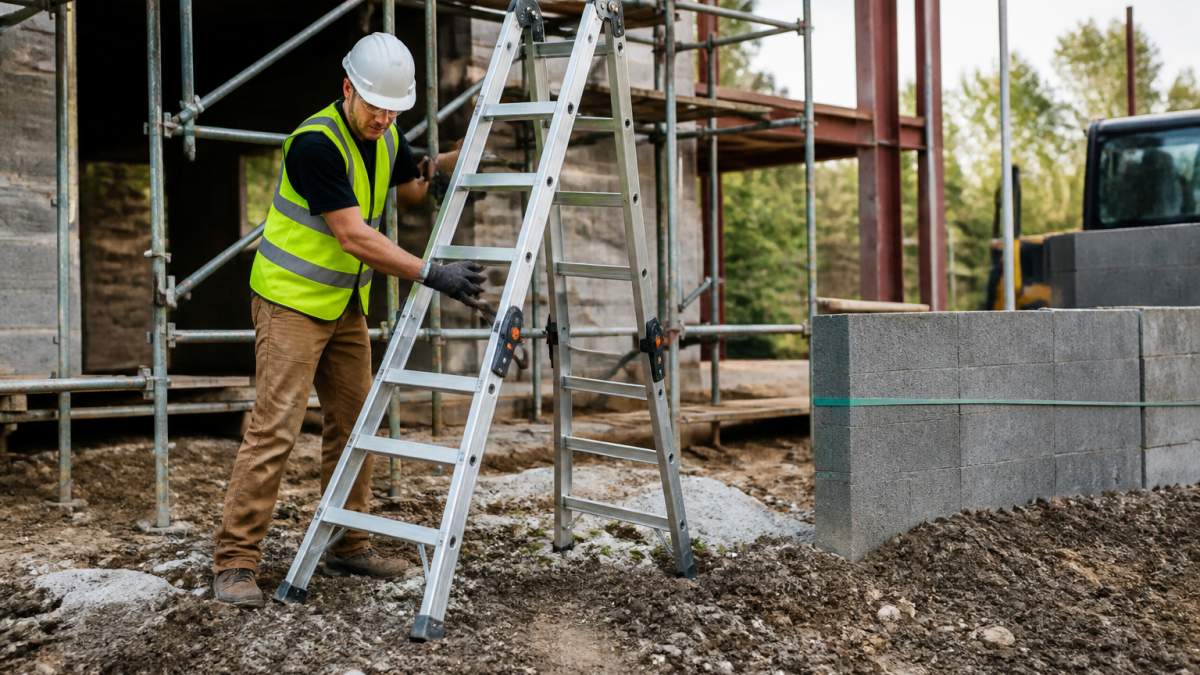
Multi-position ladders are the workhorse of modern job sites, converting between A-frame, extension, 90-degree, and scaffold positions so one ladder covers tasks that would otherwise require three.
The critical feature on uneven ground is independent leveling: separately adjustable legs compensate for a slope, curb, or staircase without blocking. This is where general-purpose ladders fail and purpose-built models earn their place on the truck.
Fiberglass vs Aluminum Ladders for Construction
Fiberglass wins for electrical work and wet conditions; aluminum wins on weight and cost.
Fiberglass ladders are non-conductive, making them the required choice for electrical work and any task where contact with a conductor is possible.
Aluminum ladders are lighter, reducing fatigue and easing transport. Aluminum is conductive, so it is unsuitable near live electrical work, but excellent for general construction, roofing, and framing.
| Material | Best For | Key Strength | Main Limitation |
|---|---|---|---|
| Fiberglass | Electrical work, wet sites | Non-conductive, corrosion-resistant | Heavier, higher cost |
| Aluminum | General construction, roofing | Lightweight, strong | Conductive |
| Wood | Rare on modern sites | Non-conductive | Weather-sensitive, heavy |
How Each Material Fails Under Site Conditions
- Impacts and drops: Aluminum bends or dents; fiberglass cracks or chips. A bent aluminum rail can sometimes be straightened, but a cracked fiberglass rail cannot be repaired safely and must be removed from service.
- Abrasion and grit: Mud and grit work into locking mechanisms and hinge points of both materials, so hinges face the same wear if grit is not cleaned out.
- Moisture and corrosion: Aluminum corrodes from salts and chemicals; fiberglass resists corrosion but can absorb moisture if damaged, so cracked fiberglass should be replaced.
- UV exposure: Prolonged sun degrades plastic components, labels, and non-slip surfaces on both materials, and fiberglass resin can degrade over years.
A fiberglass ladder weighs more, and on a site where a worker climbs twenty times a day, that weight adds up. Match the material to the task and buy fiberglass engineered to stay manageable.
Our Conquest™ 2.0 Fiberglass is built for exactly this: a non-conductive, multi-position ladder in Hi-Viz green with a 150 kg load capacity, industrial feet for any terrain, and a V-shaped bar for gutters, rods, and pipes.

OSHA Ladder Duty Ratings Explained for Buyers
A ladder's duty rating is the maximum total load it supports, including worker, tools, and materials.
The ratings follow a fixed scale. Type III is light duty for household use.
For construction sites, Type IA is the practical minimum, and Type IAA is the safe choice for crews carrying heavy tools or materials.
A duty rating is not a marketing label but a tested load limit, and exceeding it is how ladders fail under a worker.
Ladder Height, Reach and Working Height on Site
Working height is not the same as ladder height, and confusing the two causes overreaching.
For a step ladder, safe working height is roughly the top platform or the rung below the top cap, plus the worker's reach.
The practical rule: match the ladder to the task's actual working height, not the ceiling height.
On site, roof access, ceiling work, and façade work have different reach requirements, and a multi-position ladder that adjusts height and angle covers all three without a second purchase.
A Ladder Inspection Checklist for Contractors
A ladder inspection takes under two minutes and prevents the failures that cause falls. Inspect every ladder before each shift and after any incident, drop, or unusual load, and let it lead to a clear decision: keep, repair, or remove.
What to Check Before Every Shift
- Check the rails for cracks, bends, or dents
- Inspect the feet for worn treads, missing pads, or debris
- Test every lock and hinge for positive engagement
- Look for corrosion, especially on aluminum near salt or chemicals
- Confirm the duty rating label is present and legible
Any ladder that fails a check should be tagged and removed from service immediately. A ladder with a damaged lock is a fall waiting to happen.
Repair or Replace: Decision Criteria
Remove from service permanently if:
- A fiberglass rail is cracked, crazed, or has exposed fibers
- An aluminum rail is bent, cracked, or has a sharp burr that cannot be filed smooth
- A rung is bent, cracked, or has missing anti-slip surface
- A lock or hinge is broken, seized, or will not engage positively after cleaning
- The duty rating label is missing or unreadable
Clean and return to service if:
- The only issue is mud, grease, paint, or debris in the locks or on the feet
- The feet are worn but the tread is still present and the pad is secure
- Surface corrosion is light and can be removed without pitting the metal
Repair only when the manufacturer supports it:
- Replacement feet, pads, and some lock components are commonly available for professional-grade ladders
- Never weld, straighten, or splice a rail or rung; field repairs of structural components are not safe
- After any repair, re-inspect the ladder and confirm the duty rating label is still legible
Contamination and Cleaning
Mud, concrete dust, and chemicals hide defects and accelerate wear. Clean ladders with a damp cloth and mild detergent, then dry before storage. Do not use solvents that attack fiberglass resin or plastic. Pay attention to hinge points and lock mechanisms, where grit causes the sticking that leads to false engagement.
Documentation and Tagging
A durable ladder program depends on records. Tag each ladder with a unique ID, log inspections and repairs, and remove failed ladders so another crew cannot pick them up. A simple green/red tag system shows at a glance which ladders are safe, and demonstrates due diligence if an incident is investigated.
Choosing Durable Ladders That Survive the Full Project
Durability on site comes down to three things: material quality, joint design, and how the ladder is treated between uses. A well-built ladder stored badly fails faster than a mid-range ladder that is looked after.
Lifecycle Cost and Total Cost of Ownership
A cheap ladder is expensive if it fails in month three. Real cost includes purchase price, replacement, downtime, and safety risk. A ladder that lasts five years on a busy site costs far less per year than a budget ladder replaced every season.
The math favors buying once. A professional-grade multi-position ladder that replaces three single-purpose ladders also removes the cost of buying, storing, and maintaining those three.
Transport, Storage and Damage Prevention
Most ladder damage happens off the ladder: dropped from truck beds, crushed under materials, left in the rain. Transport and storage are part of the durability equation.
- Use a dedicated ladder rack or strap the ladder securely in the truck
- Store ladders horizontally on a rack, not leaning against a wall where they can be knocked over
- Keep ladders out of standing water and away from chemical spills
- Lock ladders to the rack or store them in a locked container to prevent theft and unauthorized use
For crews that move between sites, wheels make a measurable difference. Our Conquest™ 2.0 PRO includes Tip & Glide™ wheels for transport, independent leveling legs for uneven terrain, and multi-functional safety rails that stabilize the ladder against windows and gutters.

Cheap ladders cost more than they save. Failures show up at the locks, feet, and joints, and on a construction site those failures go well beyond a replacement invoice.
Get started with Distributor of Little Giant LTD and equip your crew with ladders that hold up to the job.
Frequently Asked Questions
What duty rating is required for construction site ladders?
Construction work generally calls for Type IA or Type IAA ladders, rated at 300 lb and 375 lb respectively. Type II at 225 lb is a light-duty rating intended for occasional tasks, not daily site use. Duty rating covers the combined weight of the user, tools and materials, so a 200 lb worker carrying 60 lb of gear already needs more than Type II. Check the label before buying, and replace any ladder whose rating sticker is missing or unreadable.
What is the difference between fiberglass and aluminum ladders for construction?
Aluminum is lighter and cheaper, but it conducts electricity, which rules it out near live wiring. Fiberglass is non-conductive, resists corrosion and holds up better to weather, though it weighs more and costs more. For general framing and roofing, aluminum works well. For electrical work, maintenance or anything close to energized equipment, fiberglass is the safer choice. Many crews keep both and match the ladder to the task rather than the other way around.
How often should construction ladders be inspected for durability?
Inspect before every use, with a documented deeper check monthly or after any incident. Look at rails for cracks or bends, check that locks and braces engage fully, and confirm feet and slip-resistant steps are intact. On high-turnover sites, assign one person to log inspections so nothing is missed. Any ladder that has fallen, been struck or shows structural damage should be pulled from service immediately rather than repaired on site.
Why do multi-position ladders cost more than standard step ladders?
A multi-position ladder replaces several single-purpose ladders, adjusts to uneven terrain and often converts to a scaffold or stair position. That flexibility cuts the number of units a crew has to buy, transport and store. Products like the Conquest 2.0 PRO All-Terrain carry a 150 kg load capacity, leveling legs and safety rails, so one ladder covers roofing, window access and general site work. The higher upfront price is offset by fewer replacements over the project.
Can one ladder handle roofing, electrical work and general construction?
A multi-position fiberglass ladder covers most of it. The Conquest 2.0 Fiberglass is non-conductive, rated to 150 kg and converts between A-frame, extension and scaffold positions, with a V-bar for gutters and pipes. It suits electricians and general crews working on varied terrain. The one task it does not cover is heavy-duty industrial access at extreme heights, where a dedicated platform ladder or scaffold system is still the right tool.
What should a ladder inspection checklist for contractors include?
Cover rails, rungs, steps, feet, locks, braces and labels. Check for cracks, bends, corrosion and loose fasteners. Confirm slip-resistant surfaces still grip and that all locking mechanisms engage with an audible click. Record the date, inspector and result for each ladder. Anything with a cracked rail, missing foot or failed lock goes out of service. A written log also helps during safety audits and insurance reviews.