

Table of Contents
- Quick Comparison: Industrial Multi-Functional Ladders at a Glance
- How We Evaluated These Industrial Ladders
- Velocity 2.0: Best Entry-Level Multi-Position Ladder
- Dark Horse 2.0: Fiberglass Safety for Electrical Work
- Conquest All-Terrain and Conquest 2.0 PRO: Built for Uneven Ground
- Conquest 2.0 Fiberglass: Non-Conductive Multi-Position Ladder
- Epic: The Most Feature-Rich Multi-Functional Ladder
- Revolution 2.0: Type IA Heavy Duty Multi-Position Ladder Weight Capacity
- Frequently Asked Questions
Last Updated: October 7, 2026
Quick Comparison: Industrial Multi-Functional Ladders at a Glance
Choosing the right industrial-grade multi-functional ladder comes down to three things: load capacity, material, and how well it handles the ground you actually work on. Falls from height remain one of the leading causes of serious injury in construction, and the equipment you buy is your first line of defence. At Distributor of Little Giant LTD, we have spent over 50 years helping tradespeople, electricians and plant maintenance teams choose ladders that hold up on real job sites, not showroom floors.
Below is a direct comparison of the models we stock, followed by a breakdown of what each one is built for. If you want to buy industrial grade multi-functional ladders without guessing, start here.
| Model | Material | Load Capacity | Standout Feature | Price (BGN) |
|---|---|---|---|---|
| Velocity® 2.0 | Aluminium | 150 kg | Entry-level multi-position system | 401.00 |
| Dark Horse™ 2.0 | Fiberglass | 150 kg | Non-conductive, wide base | 501.00 |
| Conquest™ All-Terrain | Aluminium | 150 kg | Independent levelling stabilisers | 525.00 |
| Conquest™ 2.0 PRO | Aluminium | 150 kg | Safety rails for roof access | 670.00 |
| Conquest™ 2.0 Fiberglass | Fiberglass | 150 kg | V-bar for gutters and pipes | 717.00 |
| Epic™ | Aluminium | 150 kg | AirDeck® accessory port | 760.00 |
| Revolution® 2.0 | Aluminium | 136 kg (Type IA) | Ratchet® levelling legs | 567.60 |
Every model here is certified to EN131 and covered by a lifetime warranty.

How We Evaluated These Industrial Ladders
We judged each ladder on the criteria that decide whether a tool survives a working site: load capacity, material, locking mechanism durability, terrain handling, and storage footprint. Price came last, because a ladder that fails at height costs far more than the one you almost bought.
What Actually Makes a Ladder "Industrial Grade"
Industrial grade is not a marketing label but a set of measurable thresholds. When you buy industrial grade multi-functional ladders, you are paying for four things:
- Duty rating. The Revolution® 2.0 carries Type IA at 136 kg, and the rest carry a 150 kg workload limit.
- Cycle life. A residential ladder might be repositioned a few dozen times a year; an industrial ladder dozens of times a day. That is why the hinge regulators on our models, Rock Locks® and Rapid Locks®, are cast from aluminium rather than moulded from plastic. Cast metal survives the repeated shock of daily repositioning; plastic regulators are the first thing to fail on a cheap ladder.
- Certification. EN131 is the European standard for portable ladders and covers strength, stability, and durability testing. Every ladder we stock is EN131 certified. A ladder without a visible certification mark is not an industrial ladder, regardless of what the listing says.
- Warranty and service life. All models here carry a lifetime warranty.
Industrial vs. Residential: The Practical Difference on Site
The gap shows up in three places. First, load headroom: a 150 kg industrial rating covers a worker plus tools, materials, and the dynamic load of climbing. Second, stability under repositioning: industrial hinges hold their setting after thousands of cycles. Third, terrain tolerance: industrial ladders like the Conquest™ All-Terrain and the Epic™ include levelling stabilisers or ratcheting legs, because job sites are rarely flat.
Velocity 2.0: Best Entry-Level Multi-Position Ladder
The Velocity® 2.0 is the most affordable way into a genuine multi-position system. Three sections, one inner, two outer, adjust through Hinge Locks and Rock Locks® to give you A-frame, extended, 90-degree and scaffold configurations from a single unit.
At 401.00 BGN it is our entry point, and it does not cut the corners that matter: 150 kg load capacity, reinforced feet, and Rapid Locks® with Palm Buttons™ for quick, pinch-free height changes. It converts to scaffold mode with the right trestles and board.
Where it falls short: it is aluminium, so it is not the right pick for live electrical work. For general construction, painting and maintenance, it replaces three separate ladders in one collapsible frame.
Dark Horse 2.0: Fiberglass Safety for Electrical Work
Electricians should start here. The Dark Horse™ 2.0 is a multi-position ladder built from non-conductive fiberglass, so it will not conduct current near live circuits, the reason electrical and maintenance crews specify fiberglass over aluminium, even at a higher price.

It adjusts into A-frame, extended, 90-degree, stairway and scaffold positions. The wide base adds stability on flat ground, Tip & Glide™ wheels ease movement between tasks, and Rock Locks® regulators hold each setting securely. Load capacity is 150 kg.
The trade-off is weight: fiberglass is heavier than aluminium alloy, so carrying it up multiple flights is more effort, a fair exchange for non-conductive protection.
Conquest All-Terrain and Conquest 2.0 PRO: Built for Uneven Ground
Uneven terrain is where ordinary ladders become dangerous, and it is what the Conquest™ range is designed to solve. Both the Conquest™ All-Terrain and the Conquest™ 2.0 PRO use side-mounted levelling stabilisers that adjust independently, so each leg finds its own footing on sloped or broken ground.

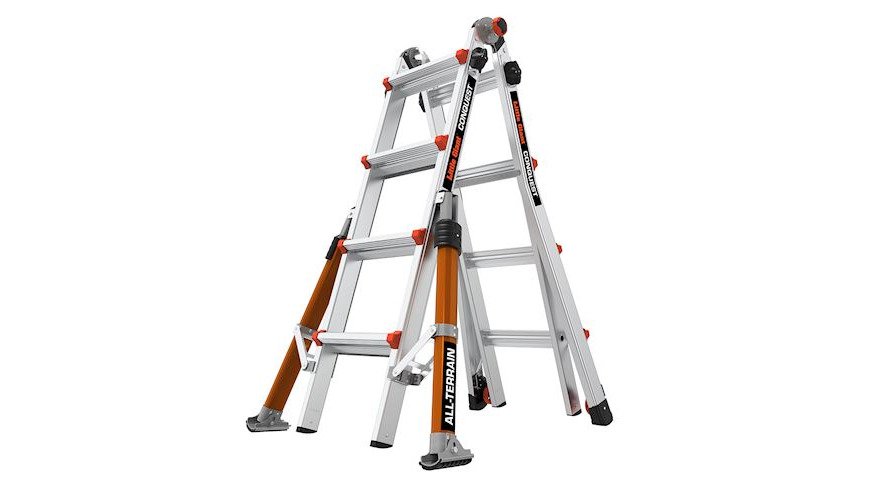
The All-Terrain (525.00 BGN) gives you levelling stabilisers, Tip & Glide™ wheels and scaffold conversion. The 2.0 PRO (670.00 BGN) adds two multifunctional Safety Rails that let you climb safely onto a roof, brace the ladder on both sides of a window, and serve as handholds on the way down.
Both carry 150 kg and use Rapid Locks® regulators. If your crews work on gravel, graded slopes or unfinished ground, the levelling legs are the difference between a stable climb and a fall.
Conquest 2.0 Fiberglass: Non-Conductive Multi-Position Ladder
For electrical work on rough ground, the Conquest™ 2.0 Fiberglass combines both requirements: non-conductive fiberglass in Hi-Viz green, with industrial feet designed for any terrain.
The spec list reads like a checklist for electrical maintenance: 150 kg load capacity, a built-in AirDeck® port for an accessory platform, a V-shaped bar for resting against gutters, rods and pipes, and full scaffold conversion. The V-bar lets the ladder sit securely against round or awkward surfaces instead of balancing on a single contact point.
At 717.00 BGN this is one of the more specialised ladders we stock.
Epic: The Most Feature-Rich Multi-Functional Ladder
The Epic™ is one of the best ladders from Little Giant Ladder Systems. It brings together features that normally appear across several models: adjustable levelling legs, transport wheels, wall stabilisers, a wall spacer, an AirDeck® accessory port and scaffold capability.
It is made from aircraft-grade aluminium, light enough to move around a site, strong enough for daily professional use, with a 150 kg load capacity. The AirDeck® port changes how a job runs: it lets you mount an accessory platform so tools and materials sit beside you at height instead of on the ground.
At 760.00 BGN it is more ladder than a homeowner needs. For contractors, plant maintenance teams and operations managers who need one ladder for roofing, general construction and complex maintenance, the Epic™ pays for itself by replacing several single-purpose tools.
Revolution 2.0: Type IA Heavy Duty Multi-Position Ladder Weight Capacity
The Revolution® 2.0 answers the question procurement teams ask most often: what is the heavy duty multi-position ladder weight capacity? This model carries a Type IA rating for loads up to 136 kg (300 lbs), meeting or exceeding OSHA and ANSI standards, and it is priced at 567.60 BGN.
That Type IA classification is built for demanding, repeated professional use rather than occasional DIY. It is made from lightweight aircraft-grade aluminium, with wider-than-standard outer rungs for comfort during long periods at height.
The standout feature is the built-in Ratchet® levelling legs, which extend and retract to keep you level on uneven surfaces. Rock Lock® regulators, cast from aluminium, provide smooth transitions between positions. It converts to A-frame, extension, 90-degree, stairway and scaffold use.
Where it falls short: the 136 kg rating is lower than the 150 kg models above, so factor that in if your crews carry heavy tool loads.
Locking Mechanism Durability: What Separates a 5-Year Ladder from a 15-Year Ladder
In practice, the locking mechanism determines whether an industrial multi-functional ladder survives its warranty period or becomes a liability.
J-locks vs. spring-loaded regulators. A J-lock uses a hooked pawl that drops into a notch. It is simple, cheap, and common on residential ladders, but every engagement abrades the notch, and after enough cycles the pawl can slip under load.
Material matters more than mechanism. A spring-loaded regulator moulded from plastic will fail faster than a J-lock machined from steel. Our regulators are cast from aluminium, which resists the impact shock of a ladder being dropped, dragged, and repositioned on site. When a ladder fails at the hinge, the cause is almost always a cracked plastic regulator, not a worn pin.
What to check before you buy. Ask three questions: (1) Are the regulators cast metal or plastic? (2) Does the lock engage with a positive click you can feel through gloves? (3) Does the manufacturer publish a cycle rating or warranty that covers the hinge? If the answer to any of these is unclear, the ladder is not built for industrial duty.
Maintenance reality. Even a cast-aluminium regulator needs attention: spray a dry lubricant into the hinge every few weeks and inspect the pin and detent for deformation during the monthly ladder inspection. Worn regulators are replaceable on our models.
Frequently Asked Questions
What makes a ladder industrial grade?
Industrial grade ladders meet EN131 certification and carry a duty rating of at least 150 kg. They use reinforced materials like aviation-grade aluminum or fiberglass and are built for daily use on professional job sites. When you buy industrial grade multi-functional ladders, check the load capacity label and certification to confirm the ladder suits your trade.
Are multi-functional ladders safe for construction sites?
Yes. Models like the Conquest All-Terrain and Revolution 2.0 meet or exceed OSHA and EN131 standards. They include features such as Rock Locks, Rapid Locks, wide base stabilizers, and non-slip feet that keep the ladder stable on job site surfaces. The ability to switch between A-frame, extension, 90-degree, stairway, and scaffold modes means one ladder handles multiple tasks without compromising safety. Always inspect locking mechanisms before each use.
Can multi-functional ladders be used on uneven terrain?
Yes. The Conquest All-Terrain and Conquest 2.0 PRO have extendable leveling legs that adjust independently to match sloped or uneven ground. The Epic also includes adjustable legs. These features let you set the ladder level on dirt, gravel, or sloped concrete without blocking or shimming. For the safest setup, extend each leg until the ladder sits flat and all four feet contact the surface.
What is the weight capacity of a heavy duty multi-position ladder?
Most Little Giant multi-position ladders in this range carry a 150 kg load capacity. The Revolution 2.0 holds a Type IA rating for up to 136 kg. This covers a worker plus tools and materials. When comparing heavy duty multi-position ladder weight capacity, check whether the rating includes the user and equipment combined. Exceeding the rated load compromises the locking hinges and structural integrity.
Should I choose an aluminum or fiberglass industrial ladder?
Choose fiberglass if you work near electricity. Models like the Dark Horse 2.0 and Conquest 2.0 Fiberglass use non-conductive fiberglass, making them safe for electrical and maintenance work. Aluminum ladders such as the Velocity 2.0, Revolution 2.0, and Epic are lighter and cost less, which suits general construction and roofing. Both materials meet EN131 when you buy industrial grade multi-functional ladders from a certified distributor.