

Table of Contents
- Little Giant vs Lagis: Quick Comparison Table
- Build Quality and Materials: Aluminum Alloy vs Fiberglass
- Stability on Uneven Terrain: Surface-Specific Testing
- Ladder Weight Capacity Standards: What the Ratings Actually Mean
- Heavy Duty Extension Ladders and Multi-Position Modes
- Professional Multi-Functional Ladder Safety: Hinges, Locks, and Compliance
- Ergonomics and Maintenance: The Long-Term Cost of Ownership
- Conclusion: Which Ladder Belongs on Your Truck?
- Frequently Asked Questions
Last Updated: September 22, 2026
Little Giant vs Lagis: Quick Comparison Table
A ladder comparison between Little Giant and Lagis comes down to one question: do you want a system built for varied job site terrain, or a lighter-duty ladder for occasional tasks? This guide from Distributor of Little Giant LTD breaks down build quality, stability, weight ratings, and long-term cost so you can decide with clear information.
The short answer: Little Giant multi-position ladders carry EN131 certification, aviation-grade aluminum construction, and load ratings from 136 kg to 150 kg. Lagis ladders typically serve the budget end of the market, with simpler configurations and lighter frames. For contractors working on uneven ground, the difference shows up fast.
Below, we compare the two across the factors that actually matter on site.
| Feature | Little Giant (Revolution 2.0) | Lagis (typical models) | Winner |
|---|---|---|---|
| Material | Aviation aluminum alloy | Aluminum | Little Giant |
| Load capacity | 136 kg (Type IA) | Varies by model | Little Giant |
| Positions | 5+ (A-frame, extension, 90°, stair, scaffold) | 2-3 typical | Little Giant |
| Leveling legs | Ratchet® system (select models) | Rarely available | Little Giant |
| Certification | EN131, OSHA, ANSI | Basic EN131 | Little Giant |
| Price | 567.60 | Lower entry point | Lagis |
| Warranty | Lifetime | Limited | Little Giant |
The table tells part of the story. The rest depends on how you actually use a ladder.

Build Quality and Materials: Aluminum Alloy vs Fiberglass
Build quality separates these two ladders more than any spec sheet suggests. Little Giant uses aviation-grade aluminum alloy, which gives a high weight-to-strength ratio: strong enough for daily trade use, light enough to carry up stairs without wearing yourself out.
Lagis ladders generally use standard aluminum.
Rail Thickness and Frame Rigidity
Rail thickness drives frame rigidity. A thicker rail resists flex when you're near the top of an extension ladder mode, which is exactly where flex becomes dangerous. Little Giant's wider base and reinforced legs on models like the Velocity 2.0 PRO add stability that thinner frames cannot match.

Stability on Uneven Terrain: Surface-Specific Testing
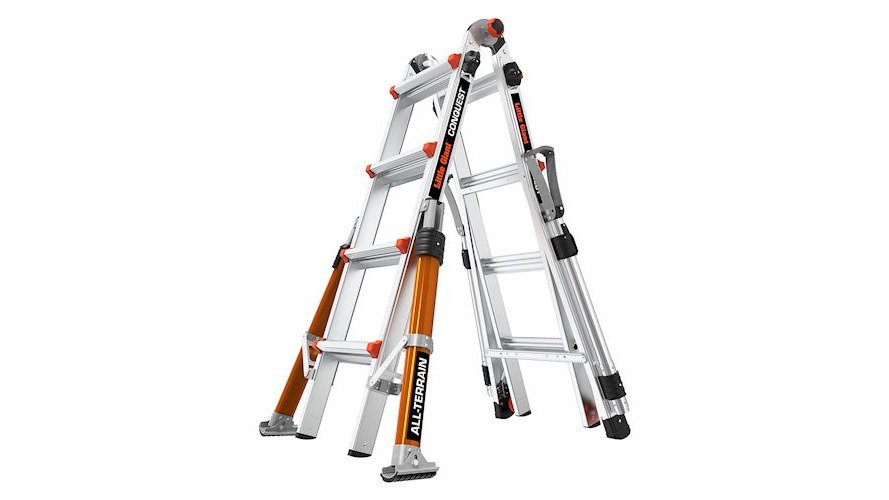
Stability on uneven ground is where a ladder comparison stops being theoretical. On a flat warehouse floor, almost any ladder feels stable. On gravel, sloped concrete, or a muddy job site, the gap widens.
How Leveling Legs and Wide Bases Change the Equation
A wide base plus leveling legs changes how the ladder transfers your weight. Instead of tipping toward the low side, the ladder stays square to the ground. Non-slip feet add grip on smooth surfaces.

Ladder Weight Capacity Standards: What the Ratings Actually Mean
Ladder weight capacity standards are not marketing numbers. They define the maximum total load, user, tools, and materials combined, and they are verified through standardized testing that most buyers never see. Understanding what the ratings actually mean prevents the single most common cause of ladder failure: overload.
How Duty Ratings Are Tested
A ladder passes if it returns to its original shape without cracking or failing. The rating on the label reflects the maximum load the ladder can support repeatedly, not a one-time breaking point. This distinction matters: a ladder rated for 136 kg is designed to carry that load thousands of times over its service life, not just once.
Calculating Your Actual Working Load
A common pattern among professionals is to underestimate combined load. A 90 kg worker plus a 15 kg tool belt plus a 10 kg material load already exceeds 115 kg, approaching the Type I limit. Add a 20 kg drill and battery pack, and a Type IA ladder becomes the minimum safe choice. The practical rule most safety officers apply is to add your body weight, the weight of everything you're wearing, and the weight of everything you're carrying, then add a 10-15% safety margin.
Why Headroom Matters More Than the Minimum
A ladder operating at its exact rated limit flexes more, wears faster, and feels less stable underfoot. Choosing a ladder rated 15-20% above your typical working load reduces flex, extends service life, and improves the felt stability that keeps workers confident at height. That is why the 150 kg capacity on many Little Giant models matters even for users who rarely exceed 120 kg total, the margin is a durability and safety feature, not just a number.
Heavy Duty Extension Ladders and Multi-Position Modes
Heavy duty extension ladders and multi-position ladders solve different problems, and Little Giant blurs the line between them. The Revolution 2.0 converts between A-frame, extension, 90-degree, stair, and scaffold configurations. One ladder replaces several.
Professional Multi-Functional Ladder Safety: Hinges, Locks, and Compliance
Professional multi-functional ladder safety depends on three components working together: the hinge mechanism, the locking pins, and the pivot points. Little Giant uses Rock Lock® regulators and palm buttons made from cast aluminum, built to resist impact and hold position under load.
ANSI, OSHA, and EN131: Which Standards Apply
EN131 is the European standard for portable ladders. Little Giant models meet or exceed EN131, and the Conquest 2.0 PRO meets and exceeds European standards.
Ergonomics and Maintenance: The Long-Term Cost of Ownership
Ergonomics and maintenance rarely appear in ladder marketing, yet they drive the real long-term cost. Two factors matter most: rung comfort over a full workday, and whether the ladder can be repaired when components wear out. Most reviews stop at weight and price. This section covers what actually determines whether a ladder lasts five years or fifteen.
Ergonomics: The Cost of Discomfort at Height
Little Giant widens the outer rungs on models like the Revolution 2.0, so you can stand longer without foot fatigue. Over a full workday, that reduces strain on your legs and knees. The thing nobody tells you about ladder ergonomics is that discomfort pushes workers to rush, and rushing at height is how accidents happen.
Maintenance and Repairability: The Gap Nobody Covers
This is the area most ladder comparisons ignore entirely, and it is where long-term ownership cost is decided. Every multi-position ladder has wear components that fail first: the feet, the hinge pins, the locking pawls, and the pivot rivets. On a ladder that is designed to be serviced, these are replaceable. On a sealed ladder, a worn foot or a sticky hinge means the whole unit goes to landfill.
What to Check Before You Buy
Before committing to any multi-position ladder, verify three things: whether replacement feet are available, whether hinge and locking components can be sourced, and whether the warranty covers those components or only the frame. A lifetime frame warranty that excludes hinges and feet is far less valuable than one that covers the parts that actually wear out.
Conclusion: Which Ladder Belongs on Your Truck?
Choosing between these two comes down to how hard you work and where. If you're a contractor, electrician, or maintenance professional dealing with uneven terrain and varied tasks, the Little Giant line is the clear pick. The Revolution 2.0 handles five configurations, carries a 136 kg Type IA rating, and includes the Ratchet® leveling system on select models.
Frequently Asked Questions
What are the key safety features of Little Giant ladders?
Little Giant ladders include several safety features across their models. The Revolution 2.0 has patented Rock Lock regulators made from cast aluminum for impact resistance, plus built-in Ratchet leveling legs for uneven surfaces. The Velocity 2.0 PRO features a quad hinge locking system and non-slip rungs. The Conquest 2.0 PRO adds multi-functional safety rails that stabilize the ladder around windows and gutters. Most models carry a Type IA rating and meet or exceed EN131 certification for the European market.
How do weight capacities compare between Little Giant and Lagis?
Little Giant multi-position ladders in the Bulgarian catalog carry load ratings between 136 kg and 150 kg depending on the model. The Revolution 2.0 is rated Type IA at 136 kg, while the Velocity 2.0, Velocity 2.0 PRO, Dark Horse 2.0, and Conquest 2.0 PRO each handle up to 150 kg. When comparing ladder weight capacity standards, check whether the rating reflects the full ladder or a single position, since multi-position ladders can have different limits in scaffold mode versus A-frame mode.
Are Little Giant ladders worth the investment for professional contractors?
The price range for Little Giant multi-position ladders runs from 401.00 to 670.00 BGN depending on the model. For contractors who currently carry separate step, extension, and scaffold ladders, one multi-position model replaces three pieces of equipment. The Velocity 2.0 at 401.00 BGN covers A-frame, extension, 90-degree, and scaffold configurations. Models like the Conquest 2.0 PRO add all-terrain leveling legs and safety rails for roof access, which matters on sites with uneven ground.
Which ladder brand offers better stability on uneven terrain?
Stability on uneven ground depends on the specific model rather than the brand alone. The Little Giant Revolution 2.0 includes built-in Ratchet leveling legs that extend and retract to compensate for sloped surfaces. The Conquest 2.0 PRO offers telescoping leveling legs plus additional side stabilizers for roof and window work. When evaluating any ladder for uneven terrain, look for leveling legs with a locking mechanism, non-slip feet, and a wide base. Ladders without leveling legs require a flat surface or separate stabilizer accessories.
Can multi-functional ladders handle both electrical work and general construction?
It depends on the material. The Dark Horse 2.0 is made from non-conductive fiberglass, which suits electricians and maintenance professionals working near live circuits. Aluminum models like the Revolution 2.0 and Velocity 2.0 conduct electricity and should not be used near energized equipment. For teams doing both electrical and general construction, a fiberglass multi-position ladder covers the widest range of tasks. All Little Giant models convert between A-frame, extension, 90-degree, staircase, and scaffold positions.