

Table of Contents
- Ladder Inspection Checklist: Pre-Use Checks for Uneven Terrain
- How to Stabilize a Ladder on a Slope
- Extension Ladder Setup on Uneven Ground: The 1-to-4 Rule and Base Security
- Ladder Safety on Stairs: Setup and Stabilization
- Terrain-Specific Setup: Soft Ground, Angled Driveways, and Sloped Surfaces
- Safe Ladder Leveling Equipment and Model-Compatible Accessories
- When to Level, Relocate, or Stop: A Decision Process for Uneven Terrain
- Frequently Asked Questions
Last Updated: October 12, 2026
Ladder Inspection Checklist: Pre-Use Checks for Uneven Terrain
Learning how to safely use ladders on uneven terrain starts before you climb. A pre-use inspection takes two minutes and catches the problems that cause falls. A cracked foot or loose lock can turn a routine job into a hospital visit.
Check these items every time:
- Rails: no cracks, bends, or dents
- Feet: rubber pads present and not worn flat
- Rungs: tight, clean, free of grease or mud
- Locks and hinges: click firmly into place
- Spreader bars: straight and locked
- Labels: legible, no missing safety stickers
Pay extra attention to the feet. On uneven ground, worn pads are the number one cause of slipping. Also check the ground itself. Look for soft soil, loose gravel, or hidden debris before you set the ladder down.
The HSE guidance on ladder safety recommends inspecting portable ladders before every use, not just at the start of the week. A ladder that sat in a truck bed overnight can pick up damage you didn't cause.
How to Stabilize a Ladder on a Slope
The best way to stabilize a ladder on a slope is to keep it out of the slope entirely. Place both feet on level ground whenever you can, even if that means moving the ladder a few metres. When level ground isn't an option, the setup depends on the slope angle and surface.
First, assess the slope. A gentle slope (less than 5 degrees) may be manageable with adjustable leveling legs. A moderate slope (5-15 degrees) often requires a ladder with built-in levelers or a stabilizer bar. A steep slope (over 15 degrees) is usually a stop condition, relocate or use a different access method.
For grassy or soft slopes:
- Face the ladder up or down the slope, never sideways.
- Set the uphill foot first, then the downhill foot.
- Use adjustable leveling legs to make up the height difference.
- Press each foot down hard to test for wobble.
- Have a helper hold the base while you climb.
For gravel or loose surfaces: Clear a patch to firm ground under each foot. If you can't reach firm ground, place wide foot pads or plywood squares to distribute weight. Avoid using rocks or bricks as shims, they can shift.
For sloped driveways or decks: Use a ladder with non-slip feet and adjustable leveling legs. If the surface is smooth and wet, consider a stabilizer bar that widens the base.
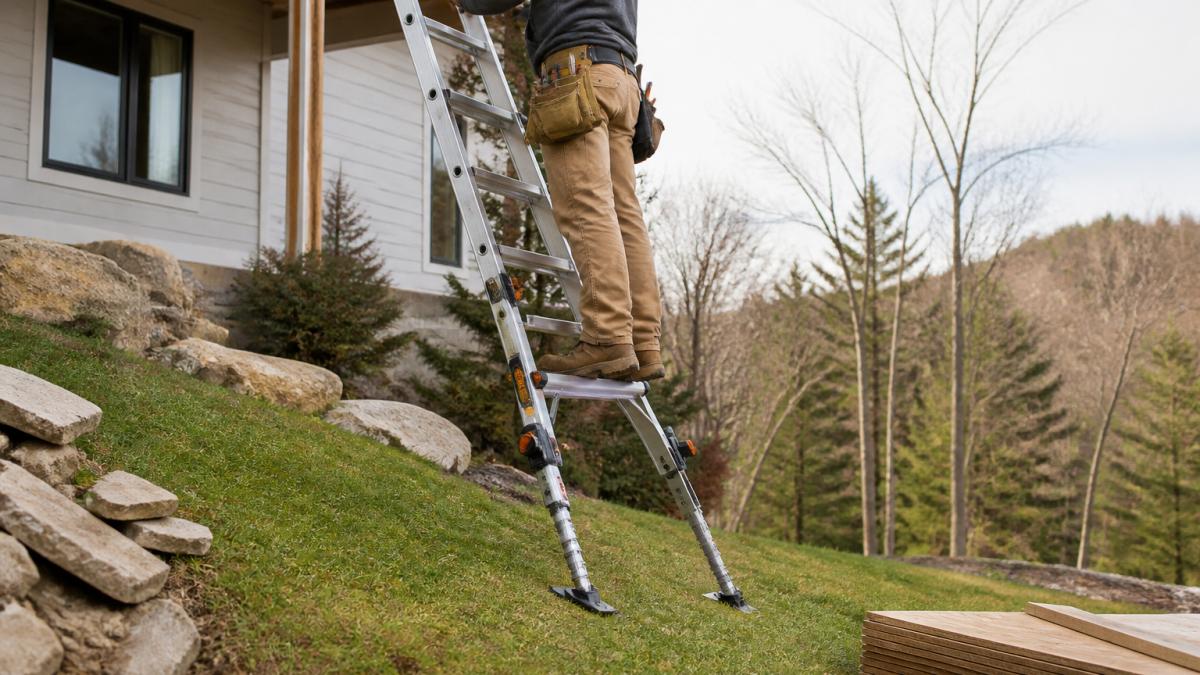
A ladder set sideways on a slope is a tipping hazard. The feet sit at different heights, and the whole frame leans. If you can't avoid a sideways setup, stop and find another spot.
If the slope is too steep or the ground too soft, don't climb. Use a scaffold tower, a platform ladder, or call a professional.
Extension Ladder Setup on Uneven Ground: The 1-to-4 Rule and Base Security
Extension ladder setup on uneven ground follows the same angle rule as flat ground: the 1-to-4 rule. For every 1 metre of height to the support point, move the base 0.25 metres away from the wall. But on uneven ground, base security matters more than angle. A ladder at the perfect angle still slides if the feet can't grip.
Apply the 1-to-4 rule with these steps:
- Measure the working height first.
- Divide by four to get your base distance.
- Mark the spot and check the ground under it.
- Clear rocks, tools, and loose material.
- Set the feet and test for movement.
Terrain-specific base security:
- Soft soil or grass: Feet sink. Dig shallow flat spots for each foot, or use wide foot pads to spread the load. A common pattern is to carry a small spade for this.
- Gravel: Feet roll. Clear a patch to firm ground. If that's not possible, place a plywood board under both feet to create a stable base.
- Uneven hard surfaces (e.g., cracked concrete): Feet may not sit flat. Use adjustable leveling legs to make up the difference. Never stack bricks or wood scraps, they can shift.
- Sloped surfaces: Use a ladder with built-in levelers. If the slope is too steep for the levelers, relocate.
When to level, relocate, or stop:
- Level: If your ladder has adjustable leveling legs and the slope is within their range (check the manufacturer's limits), set them so both feet bear equal weight.
- Relocate: If the ground is too soft, too steep, or too uneven for your ladder's accessories, move to a better spot.
- Stop: If you can't make the surface stable, don't climb. Use a scaffold, a platform, or get qualified help.
Always follow the ladder manufacturer's instructions for your specific model. Accessories and setup requirements vary by ladder.
Ladder Safety on Stairs: Setup and Stabilization
Ladder safety on stairs comes down to one rule: never let a ladder rest on a step edge. Stair treads are narrow and rounded, so feet slip off them easily.
Use a ladder with adjustable legs that can be set at different heights. Set the uphill leg shorter and the downhill leg longer so both feet land on flat surfaces. Many multi-position ladders are built for exactly this.
What to avoid:
- Resting a rail on a stair tread
- Stacking boards or bricks under one foot
- Using a step stool on a landing and reaching over the edge
- Climbing with the ladder at an angle across the stairs
For stairwell work, a ladder that converts to a scaffold position gives you a stable platform instead of a balancing act.
Terrain-Specific Setup: Soft Ground, Angled Driveways, and Sloped Surfaces
Different ground needs different handling. There is no single setup that works everywhere, so match your approach to the surface.
| Terrain | Main Risk | Best Fix |
|---|---|---|
| Soft soil or grass | Feet sink | Dig flat spots or use wide foot pads |
| Angled driveway | Ladder leans | Adjustable leveling legs |
| Gravel | Feet slide | Clear a patch to firm ground |
| Sloped decking | Slippery surface | Non-slip feet and a helper |
| Stairs | Feet miss treads | Adjustable legs set at two heights |
On soft ground, weight pushes the feet down and the ladder tilts. On gravel, the feet roll. On smooth sloped surfaces, they slide. Each problem has a fix, but only if you spot it before you climb.
Safe Ladder Leveling Equipment and Model-Compatible Accessories
Safe ladder leveling equipment is the difference between a stable climb and a gamble. The key word is compatible. Accessories only work if they're made for your exact ladder model.
Options that work well:
- Built-in leveling legs with ratchet adjustment, like those on the Little Giant Leveler™
- Side-mounted stabilizers that widen the base on rough ground
- Foot pads sized for soft or slippery surfaces
- Chocks placed behind the feet on a slope
Never bolt on a generic accessory that isn't listed for your ladder. A leveler that doesn't match the rail profile can slip under load. Check the manufacturer's instructions for your model before adding anything.
The OSHA portable ladder requirements are clear that accessories must be used as the maker intends. If the manual doesn't mention it, don't fit it.
The Leveler™ from our range is built for this exact problem. It has adjustable Ratchet™ leveling legs, Palm Buttons™, and non-slip foot caps. It handles uneven ground and stairs, holds up to 150 kg, and converts to a scaffold.
When to Level, Relocate, or Stop: A Decision Process for Uneven Terrain
Not every slope is worth working on. Use this simple process before you set up:
- Can you move the ladder to level ground? If yes, move it.
- Can your ladder's leveling legs cover the gap? If yes, level it.
- Is the slope too steep for the legs? Relocate or use a scaffold.
- Is the ground soft, loose, or unstable? Stop. Find another approach.
If you reach step four, don't climb. No job is worth a fall from height. Bring in a platform, a scaffold tower, or a different access method.
The NIOSH ladder fall prevention resources note that falls remain one of the leading causes of workplace deaths. Most happen on ladders set up on poor ground.
For crews who work on varied sites every day, a ladder built for the job pays for itself. The Conquest™ 2.0 PRO has extendable leveling legs, side stabilizers, and Tip & Glide™ wheels. It holds 150 kg and meets EN131. For electrical work, the Conquest™ 2.0 Fiberglass adds a non-conductive frame in Hi-Viz green.
Frequently Asked Questions
How to stabilize a ladder on a slope?
Use a ladder with adjustable leveling legs, such as the Little Giant Leveler™ or Conquest™ All-Terrain. These have ratchet-style legs that extend independently to match the slope. Position the ladder so both feet rest on firm ground, then lock the legs. If the slope is too steep or the ground is soft, relocate the ladder or build a stable base. Never use bricks, blocks, or other makeshift supports.
Can you use a ladder on uneven ground?
Yes, but only with the right equipment and setup. Standard ladders are not designed for uneven ground and can slip or tip. Use a multi-position ladder with leveling legs or a ladder leveler accessory. Ensure all feet are on solid, level surfaces. If the ground is too uneven, consider an alternative like a scaffold or a different access method. Always follow the manufacturer's instructions for your specific model.
What should you do if a ladder's feet are not level?
Stop and do not climb. If the ladder's feet are not level, you must adjust the setup. Use a ladder with built-in leveling legs or attach a compatible leveler. If that is not possible, move the ladder to a more level spot or create a stable, flat base using approved methods. Never force the ladder to sit level by placing objects under one foot. Check that all feet are firmly planted before climbing.
When should you avoid using a ladder on uneven terrain?
Avoid using a ladder if the slope is too steep for your leveling equipment, if the ground is soft or unstable (such as mud or loose gravel), or if you cannot secure all feet on firm footing. Also avoid if you lack a helper to steady the base or if the ladder cannot be positioned at the correct 1-to-4 angle. In these cases, use a scaffold, aerial lift, or other safe access method instead.
Uneven terrain is where most ladder accidents begin, and it's the one variable you can control before you climb. At Distributor of Little Giant LTD, we've spent over 50 years building ladders that stay stable when the ground won't. Our multi-position models come with adjustable leveling legs, non-slip feet, and EN131 certification, plus a lifetime warranty. Get started with Distributor of Little Giant LTD and work at height with confidence, whatever the ground looks like.