

Table of Contents
- How to Compare Professional Ladder Brands for Construction
- What Separates a Jobsite Ladder From a Hardware-Store Model
- Ladder Types for Construction Work: Matching the Model to the Task
- Side-by-Side: Five Little Giant Models Built for Construction Sites
- Ladder Load Capacity Ratings Explained: EN 131 Classes and What They Mean on Site
- Professional Ladder Safety Features That Change How You Work at Height
- Your Ladder Comparison Checklist Before You Buy
- Verdict: Which Ladder Fits Your Trade and Your Truck
- Frequently Asked Questions
Last Updated: October 17, 2026
How to Compare Professional Ladder Brands for Construction
Comparing professional ladder brands for construction comes down to four things: certified load class, material, handling of uneven ground, and after-sale support. This guide from Distributor of Little Giant LTD walks through each filter using our own catalogue, so you can judge a ladder on evidence rather than a spec sheet.
Most buying guides rank ladders by height and price, which misses the point on a live site. A ladder that shifts on gravel, or fails inspection because its class marking is unclear, costs a crew far more than the difference between two models.
What Separates a Jobsite Ladder From a Hardware-Store Model
A jobsite ladder is built for repeated use by people who are paid to be up there; a hardware-store model is built for occasional household tasks. The gap shows up in three places: the duty class printed on the rail, the stability of the feet and base, and whether the ladder survives daily loading and unloading.
Domestic ladders sit at the lighter end of the EN 131 classes, while professional models are certified to the heavier classes and tested for sustained use. When procurement asks why one ladder costs several times another, this is the first honest answer.
Ladder Types for Construction Work: Matching the Model to the Task
Match the ladder type to the task before you compare brands. Three categories cover most construction work: step ladders for low, frequent tasks; extension ladders for access to height; and multi-position ladders for crews that need one platform to do several jobs.
Step, Extension, and Multi-Position Ladders Side by Side
Step ladders are the A-frame workhorses, suited to electrical fit-out, ceiling work, and anything where you need both hands at a modest height.
Extension ladders lean against a structure for straight-line access to roofs and upper floors. The King Kombo™ Industrial covers this role and more: a 3-in-1 ladder that works as a leaning ladder and an A-frame, with a V-bar for corners, poles and columns.
Multi-position ladders fold into several configurations, including scaffold replacement. The Conquest™ 2.0 PRO, Conquest™ 2.0 Fiberglass and Velocity® 2.0 PRO all fall here.

| Ladder type | Best for | Example model |
|---|---|---|
| Step ladder | Electrical, ceiling, low tasks | A-Force300XP |
| Extension / combination | Roof access, corners, poles | King Kombo™ Industrial |
| Multi-position | Mixed tasks, scaffold mode | Conquest™ 2.0 PRO |
Side-by-Side: Five Little Giant Models Built for Construction Sites
Five models in our range cover the construction market, each certified to EN 131 and each solving a different site problem.
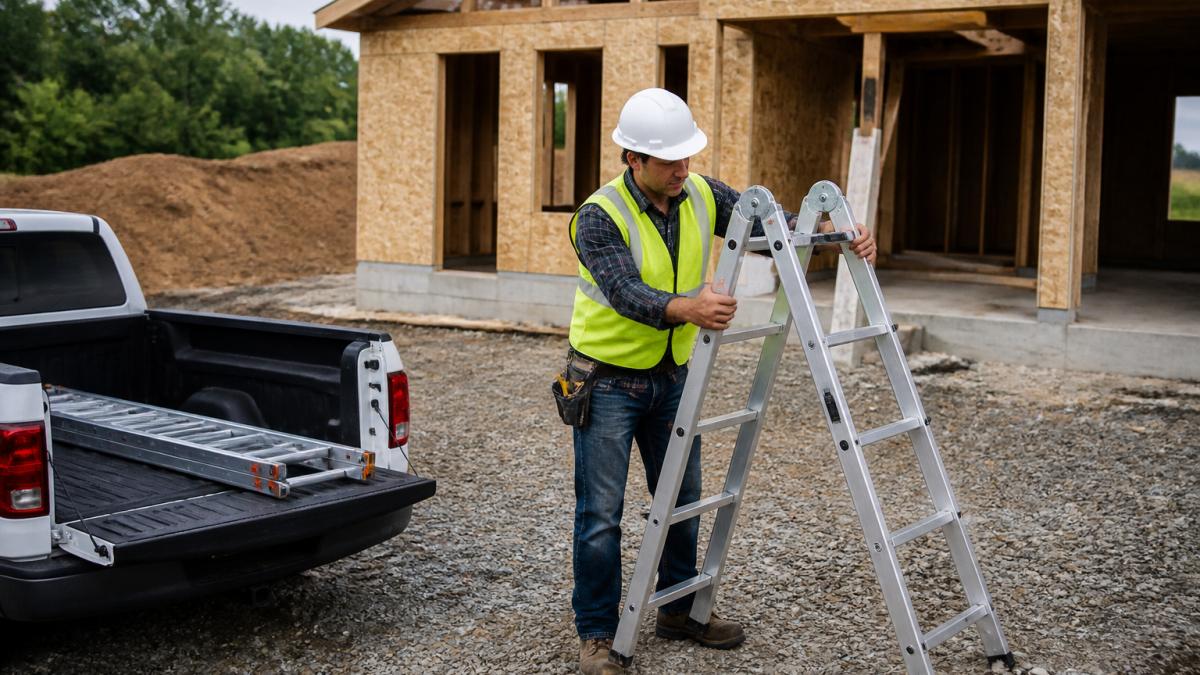
Conquest™ 2.0 PRO (670.00) is the all-terrain multi-position ladder.
Conquest™ 2.0 Fiberglass (717.00) takes the same multi-position platform and makes it non-conductive.

Velocity® 2.0 PRO (554.00) is the value multi-position option: wide base, non-slip steps, four-way locking hinge, Tip & Glide™ wheels, scaffold mode, and 150 kg capacity. The AirDeck® accessory is sold separately.
Ladder Load Capacity Ratings Explained: EN 131 Classes and What They Mean on Site
Ladder load capacity ratings explained simply: EN 131 is the European product standard for portable ladders, sorting them into duty classes based on the maximum total load the ladder supports.
The EN 131 framework distinguishes between domestic and professional duty classes.
Two rating systems are often confused. EN 131 is the European standard and uses metric load classes.
| Rating system | Typical professional classes | What it signals |
|---|---|---|
| EN 131 (Europe) | Professional duty classes | Certified for sustained professional use; metric load basis |
| ANSI Type IA (US) | Extra heavy duty | 300 lbs (~136 kg) rated capacity |
| ANSI Type IAA (US) | Special duty | 375 lbs (~170 kg) rated capacity |
| ANSI Type I (US) | Heavy duty | 250 lbs (~113 kg) rated capacity |
The models in our range carry stated capacities of 136 kg and 150 kg, and the Conquest™ PRO line is stated to meet and exceed all European standards.
A capacity figure is a ceiling, not a target.
Compliance does not stop at the class marking.
For a fuller picture of how the standard is applied, the European Committee for Standardization publishes the EN 131 framework that national bodies adopt, and the Health and Safety Executive guidance on ladder use explains how working-at-height equipment is assessed in practice.
Professional Ladder Safety Features That Change How You Work at Height
Professional ladder safety features are the ones that keep a ladder planted when the ground is not level, and they are where the real difference between brands shows up.
Stabilizers, safety rails, and V-bars. These address what the ladder leans against, not what it stands on.
Locking mechanisms and hinges. A ladder that folds is only as safe as its locks. The Velocity® 2.0 PRO uses a four-way locking hinge; the Conquest™ PRO line uses Rapid Locks® adjusters.

Wheels and transport systems. Frequent repositioning is a jobsite reality, and the difference between a ladder that gets moved and one left in the van is often how easily it moves.
Ground-level indicators and step feedback. The King Kombo™ Industrial's Ground Cue™ system sounds when a climber reaches the bottom step, reducing the common misstep of stepping off before the last rung.
| Jobsite condition | Feature that solves it | Example in our range |
|---|---|---|
| Gravel, slopes, soft ground | Independent leveling legs or all-terrain feet | Conquest™ 2.0 PRO; Conquest™ 2.0 Fiberglass |
| Roof access, window openings | Multifunctional safety rails | Conquest™ 2.0 PRO |
| Corners, poles, round columns | Rotating corner accessory / V-bar | King Kombo™ Industrial |
| Frequent repositioning | Locking transport wheels | A-Force300XP (HoverGlide™); Conquest™ / Velocity® (Tip & Glide™) |
| Multi-configuration use | Serviceable locking hinges | Velocity® 2.0 PRO (four-way hinge); Conquest™ PRO (Rapid Locks®) |
Your Ladder Comparison Checklist Before You Buy
Run every candidate ladder through the same checklist. It takes ten minutes and prevents the most expensive mistake in ladder buying: a fleet that does not match the work.
- Duty class and capacity: Is the EN 131 class marked clearly, and does the stated capacity cover the heaviest climber plus tools?
- Material: Fiberglass for any electrical exposure, aluminum where weight and cost matter more.
- Terrain handling: Leveling legs or all-terrain feet if your sites include gravel, slopes or soft ground.
- Stability features: Side stabilizers, safety rails, V-bars or corner accessories for the surfaces you lean against.
- Locking mechanism: Named and serviceable, with a hinge or lock system you can inspect.
- Configurations: Does it convert to scaffold mode, or cover step, extension and A-frame roles in one unit?
- Transport and storage: Tip & Glide™ or HoverGlide™ wheels, folded footprint, and whether it fits your van rack.
- Warranty and repairability: What is covered, for how long, and can parts be replaced rather than the whole ladder?
- Total cost of ownership: Purchase price plus expected service life, not purchase price alone.
That last point deserves emphasis. A cheaper ladder replaced every couple of years usually costs more than a certified professional model that lasts. When procurement asks about durability and warranty, the honest answer is to compare cost per year of service, not sticker price. The Health and Safety Executive guidance on ladder use is a useful external reference for how working-at-height equipment is assessed in practice.
Verdict: Which Ladder Fits Your Trade and Your Truck
Our verdict, stated plainly: buy by trade, not by brand loyalty.
- Electricians and maintenance teams: the Conquest™ 2.0 Fiberglass (717.00) or King Kombo™ Industrial (305.00). Non-conductive rails, and the King Kombo adds corner protection for interior work.
- General contractors on mixed terrain: the Conquest™ 2.0 PRO (670.00). Leveling legs, safety rails and scaffold mode cover the widest range of site conditions.
- Crews watching budget without giving up capacity: the Velocity® 2.0 PRO (554.00) at 150 kg, with the AirDeck® accessory added separately.
- Fit-out and electrical second-fix work: the A-Force300XP (345.00), a fiberglass step ladder with tool storage built in.
Every model here is certified to EN 131, backed by more than 50 years of Little Giant innovation, and available through us as an authorised distributor.
The hard part of buying ladders is not choosing a model. It is proving to a procurement team that the investment holds up on an active site. Explore the Conquest™ 2.0 PRO and the rest of our professional range, and get your crews onto equipment that stays planted.
Frequently Asked Questions
What brand makes the best ladders for construction professionals?
There is no single winner, but the strongest construction ladders share three traits: EN 131 certification, a 150 kg load capacity, and a design that stays stable on uneven ground. Little Giant models such as the Conquest 2.0 PRO and Conquest 2.0 Fiberglass meet those marks, and the fiberglass version adds non-conductive protection for electrical work. Compare professional ladder brands on those specs first, then on repairability and warranty, because a ladder that lasts ten years costs less per job than one replaced every two.
What is the difference between Type I, Type IA, and Type IAA ladders?
These are US duty ratings, and they map roughly onto European EN 131 classes. Type I is heavy duty at around 113 kg, Type IA is extra heavy duty at around 136 kg, and Type IAA is special duty at around 170 kg. The Little Giant A-Force300XP carries a Type IA rating with a 300 lb (about 136 kg) limit. For most construction crews in Europe, look for the EN 131 marking and a stated load capacity of at least 150 kg rather than the US label alone.
What ladder type is best for uneven construction-site terrain?
A multi-position ladder with adjustable leveling legs handles uneven ground better than a standard step or extension ladder. The Conquest 2.0 PRO has extendable leveling legs that adapt to sloped or broken surfaces, plus side stabilizers and a 150 kg capacity. If your crew works on gravel, trenches, or unfinished floors daily, that leg adjustment is the feature that decides whether the ladder sits flat or rocks under load. Pair it with slip-resistant feet for extra grip.
How should contractors compare ladder load ratings?
Compare the stated load capacity, the standard it is certified to, and whether that capacity holds across every position the ladder can take. A multi-position ladder rated at 150 kg should carry that load in A-frame, extension, and scaffold modes. Check the EN 131 marking, confirm the duty class, and weigh it against what your crew actually carries: tools, materials, and a person often add up fast. A ladder rated well above your heaviest realistic load lasts longer and feels steadier.
What features should professionals look for in a construction ladder?
Prioritize EN 131 certification, a load capacity of at least 150 kg, and stability features such as leveling legs, side stabilizers, and slip-resistant feet. Then look at the details that affect daily work: a locking mechanism that engages firmly, a top cap or tool tray that keeps fasteners in reach, and wheels for moving the ladder alone. For electrical work, specify non-conductive fiberglass. The King Kombo Industrial adds a Ground Cue system that signals when you reach the bottom rung, which reduces missteps on busy sites.