

Table of Contents
- The Real Cost of Owning Multiple Ladders
- Multi-Position Ladder Pros and Cons: An Honest Assessment
- Multi-Position Ladder vs Extension Ladder: Which Fits Your Work?
- Multi-Functional Ladder Safety: Standards, Ratings, and Real Risks
- Multi-Position Ladder for Uneven Ground: How Leveling Legs Change the Game
- Comparing Multi-Functional Ladders: Which Model Delivers the Best Long-Term Value?
- Who Should Not Buy a Multi-Functional Ladder
- Conclusion: The Investment Case for Multi-Functional Ladders
- Frequently Asked Questions
Last Updated: October 15, 2026
The Real Cost of Owning Multiple Ladders
Most tradespeople and serious DIYers don't set out to own three ladders, they accumulate them: a step ladder for indoor jobs, an extension ladder for roof access, a telescopic ladder for the van.
The real cost isn't the sticker price of one ladder, but the combined purchase price, replacement cost when a cheap ladder fails, and storage space three ladders consume.
Here's how the numbers typically stack up for a working professional:
| Cost Factor | Three Dedicated Ladders | One Multi-Functional Ladder |
|---|---|---|
| Initial investment | Spread across 3 purchases | Single upfront cost |
| Storage footprint | Two to three times the space | Folds to one unit |
| Replacement cycle | Staggered, unpredictable | One warranty, one unit |
| Transport | Multiple trips or a bigger van | Folds and rolls |
| Maintenance | Three sets of checks | One inspection routine |
European Commission guidance on ladder safety at work makes clear that equipment stability and correct setup are the primary factors in ladder-related incidents, which is exactly where a single well-built system beats a mismatched collection of cheap ladders.
Multi-Position Ladder Pros and Cons: An Honest Assessment
A multi-position ladder adjusts into several configurations: A-frame, extended, 90-degree, staircase, and scaffold. That flexibility is the pitch, but the honest assessment has to include numbers.
The genuine pros:
- One ladder replaces three or four dedicated units. A typical setup, a 6 ft step ladder, a 24 ft extension ladder, and a compact telescopic for the van, often costs the same as one professional multi-position ladder, but with three storage footprints and replacement cycles.
- Folds into a compact unit. Folded, it occupies roughly the footprint of a single step ladder rather than the full length of an extension ladder, the difference between fitting in a van and needing a roof rack.
- Adjustable height covers most jobs without swapping equipment: A-frame indoors, extension for wall access, scaffold base for two-person tasks.
The honest cons:
- Heavier than a single-purpose step ladder of similar height, thanks to the hinge, locking mechanisms, and extra sections.
- Setup takes longer than unfolding a basic A-frame. Unlocking, repositioning, re-locking, and verifying adds time per move, compounding on jobs with frequent repositioning.
- Costs more upfront than a budget hardware-store ladder. That premium pays for the hinge and locking system, exactly where cheap ladders cut corners.
The total cost of ownership angle most buyers miss. Over a five-year working life, compare purchase price plus maintenance plus replacement parts plus the storage and transport cost of the alternative. A multi-position ladder that replaces three dedicated units usually wins on combined purchase price, storage, and replacement cycle. It can lose if the hinge wears early on a cheap model, which is why the build quality of the locking system decides whether the investment pays off.
Who should not buy one. If your work is genuinely one-dimensional, gutter cleaning on single-storey homes, or maximum reach against a tall wall, a dedicated step or extension ladder is lighter, simpler, and cheaper.
A quick decision framework by frequency of use:
- Occasional DIY, one or two jobs a year, flat ground: a basic step or extension ladder is usually the better buy.
- Regular DIY or light trade work, varied tasks, limited storage: a multi-position ladder earns its premium.
- Daily professional use across multiple sites and terrains: a professional multi-position ladder with verified duty rating and a serviceable locking system is the only version worth buying.
The pros and cons depend on how often you climb, what you climb onto, and whether you'll maintain the mechanism that keeps you up there.
Multi-Position Ladder vs Extension Ladder: Which Fits Your Work?
An extension ladder wins on one thing: straight-line reach against a wall or roof edge. A multi-position ladder wins on everything else.
The Health and Safety Executive guide to safe ladder use recommends matching the ladder type to the specific task and ground conditions rather than defaulting to one ladder for everything, which is precisely the case for a configurable system.
Compare the two directly:
| Feature | Multi-Position Ladder | Extension Ladder |
|---|---|---|
| Configurations | A-frame, extended, 90-degree, staircase, scaffold | Extended straight only |
| Best for | Varied tasks, indoor and outdoor | Straight wall and roof access |
| Storage | Folds compact | Long, awkward to store |
| Setup on uneven ground | Leveling legs available | Rarely adjustable |
| Versatility | High | Low |
For roofing, electrical work, and general construction, the extension ladder is a specialist tool; the multi-position ladder is the generalist that covers the specialist's job most of the time.
Multi-Functional Ladder Safety: Standards, Ratings, and Real Risks
Safety on a multi-functional ladder comes down to three things: certification, load rating, and setup. Get any one wrong and the others don't save you.
Look for certification to EN 131, the European standard governing portable ladders. It covers strength, stability, and durability testing, verifying a ladder against a defined benchmark rather than a manufacturer's own claims.
The real-world risks are boring and predictable: setup on soft or sloped ground, a hinge not fully locked, overreaching sideways instead of repositioning. All are preventable with a ladder that locks properly and legs that adjust.
OSHA guidance on portable ladder safety reinforces the same principles for ladder setup and inspection that apply on both sides of the Atlantic, and they're worth reading once regardless of where you work.
Multi-Position Ladder for Uneven Ground: How Leveling Legs Change the Game
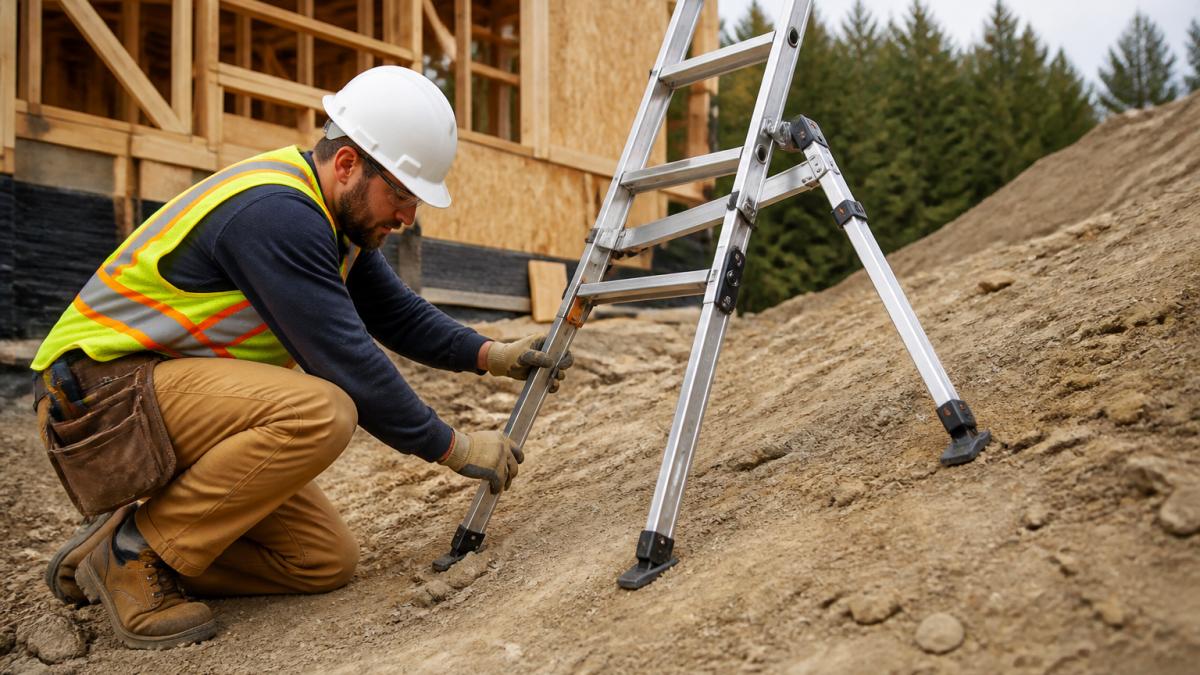
Uneven ground is where most ladders fail in practice. A standard ladder on a slope sits on two points, tips at the third, and the operator compensates by leaning, how incidents start.
Task-by-task: when leveling legs actually earn their keep
- Sloped driveways and paths. A standard A-frame on a slope has one leg short of the ground; leveling legs extend to meet it, so the ladder sits on four points instead of two.
- Uneven dirt and gravel job sites. Soft ground shifts under load. Independent leveling legs let each corner find its own footing, something a shared adjustment system cannot do when the slope runs in two directions.
- Staircases and split levels. A staircase position is a distinct configuration, not a leveling-leg feature, but the two often go together: a ladder that can sit on a step and level itself is the difference between safe access and a propped-up compromise.
When a dedicated ladder is the better choice
- Flat, firm ground and a single task. If the ground is level and the job is straight wall access, a dedicated extension ladder is lighter, simpler, and cheaper. Leveling legs add weight and setup steps you will never use.
- Maximum reach against a tall wall. A dedicated extension ladder still wins on straight-line reach. A multi-position ladder covers most of that range, but not all of it, and not as light.
- Frequent repositioning on flat ground. Setup time matters. If you move the ladder every few minutes on level concrete, a basic A-frame is faster to deploy than any configurable system.
How independent leveling legs differ from shared systems. A single shared leveling system can't compensate for a slope that runs in two directions at once; independently adjustable legs can.
The real-world trade-off. Leveling legs add weight and setup steps: on a flat site that's cost without benefit, but on a sloped or soft site it's the difference between a stable ladder and a compromise. The question isn't "are leveling legs good" but "does my work put me on uneven ground often enough to pay for them." If yes, they justify the multi-position ladder; if no, a simpler ladder is the better buy.
Comparing Multi-Functional Ladders: Which Model Delivers the Best Long-Term Value?
Long-term value on a multi-functional ladder comes down to three variables: how often you'll use it, what terrain you work on, and whether you need non-conductive material.
Here's how the models in our range compare on the factors that actually drive total cost of ownership:
| Model | Price | Key Strength | Best For |
|---|---|---|---|
| Velocity® 2.0 | 401.00 | Reinforced legs, Rapid Locks®, scaffold conversion | General trades, varied tasks |
| Velocity® 2.0 PRO | 554.00 | Wide base, Tip & Glide™ wheels, AirDeck® port | Frequent transport, extended jobs |
| Conquest™ All-Terrain | 525.00 | Side-mounted leveling stabilizers, scaffold conversion | Uneven job sites |
| Conquest™ 2.0 PRO | 670.00 | Leveling legs, Safety Rails, roof and window access | Roofing, window and gutter work |
| Dark Horse™ 2.0 | 501.00 | Non-conductive fiberglass, wide base | Electrical and maintenance work |
The Velocity® 2.0 is the entry point and the one we'd point a general contractor toward first.

For uneven ground, the two Conquest™ models are the answer.
Then there's the Dark Horse™ 2.0. It's the one electricians and maintenance crews should look at first, because it's built from non-conductive fiberglass rather than aluminum.
Who Should Not Buy a Multi-Functional Ladder
A multi-functional ladder is the wrong purchase if your work is genuinely one-dimensional.
There's also a case against it for anyone who won't maintain it. The hinge and locking mechanisms are the parts that fail, and a ladder that's never inspected eventually surprises you.
For everyone else, the case is straightforward: you're buying one ladder that replaces three, folds into a fraction of the space, and stays stable on ground that would defeat a standard unit.
Conclusion: The Investment Case for Multi-Functional Ladders
The honest answer to whether multi-functional ladders are worth the investment is that they are, for anyone whose work varies. The upfront price is higher than a single budget ladder but lower than the combined cost of the three or four ladders it replaces, and it keeps paying back in storage space, transport time, and replacement cycles you never have to run.
Our range is certified to EN 131, rated to 150 kg, and backed by a lifetime warranty, with models for general trades, uneven terrain, and non-conductive electrical work.
Frequently Asked Questions
Are multi-functional ladders worth the investment for a professional contractor?
For contractors who regularly switch between tasks like roof access, electrical work, and general construction, multi-functional ladders can replace two or three single-purpose ladders. The upfront cost is higher than a basic step ladder, but the long-term value comes from not buying separate ladders for every job. Look for models with a 150 kg weight capacity and EN131 certification to ensure they hold up on active job sites.
What are the advantages of a multi-position ladder over a traditional step ladder?
A multi-position ladder adjusts into A-frame, extension, 90-degree, staircase, and scaffold positions, while a step ladder only works in one configuration. This versatility means fewer trips back to the truck and less downtime. Many models also fold compactly for storage, which matters when space on site is limited. The trade-off is a higher purchase price and slightly heavier weight than a basic step ladder.
Are multi-position ladders suitable for uneven ground?
Some multi-position ladders are specifically designed for uneven terrain. Models like the Conquest 2.0 PRO feature extendable leveling legs that adjust independently to keep the ladder stable on sloped or rough surfaces. If you frequently work on uneven ground, look for a ladder with this feature and check its duty rating to confirm it meets the load requirements of your tasks.
How much does a multi-position ladder typically cost?
Prices vary by model and features. In the Little Giant range, the Velocity 2.0 starts at 401.00, the Dark Horse 2.0 is 501.00, the Conquest All-Terrain is 525.00, the Velocity 2.0 PRO is 554.00, and the Conquest 2.0 PRO is 670.00. When comparing, factor in the cost of the two or three separate ladders each model replaces, plus the storage space you save.
What should professionals look for when buying a multi-functional ladder?
Check the duty rating and weight capacity (150 kg is standard for professional use), the locking mechanism type (Rapid Locks or Rock Locks for quick adjustments), and whether it meets EN131 certification. For electrical work, choose a fiberglass model like the Dark Horse 2.0 for non-conductive properties. Also consider folded dimensions for transport and storage, and whether the ladder converts to a scaffold for wider tasks.
If your current setup is a mismatched collection of ladders that each solve one problem, the challenge isn't finding a better ladder. It's finding one that solves all of them. Explore our multi-functional ladder range, compare the Velocity®, Conquest™, and Dark Horse™ models against the work you actually do, and pick the configuration that matches your terrain. Get started with Distributor of Little Giant LTD and replace the pile in your van with a single certified system.