

Table of Contents
- Multi-Functional Ladders for Construction: What Sets Them Apart
- Key Features for Professional Construction Environments
- OSHA Ladder Safety Requirements for Job Sites
- Ladder Stability on Uneven Ground: How It Works
- Industrial Ladder Weight Ratings: What You Need
- Top Multi-Functional Ladder Models Compared
- Choosing the Right Ladder for Your Job Site
- Storage and Transport on Work Trucks
- Frequently Asked Questions
Last Updated: September 25, 2026
Multi-Functional Ladders for Construction: What Sets Them Apart
The best multi-functional ladders for construction sites adapt to different positions, handle uneven terrain, and meet safety standards that protect your team. One versatile tool replaces multiple ladders, working across roofing, electrical work, interior tasks, and more.
At Distributor of Little Giant LTD, we offer innovative ladder solutions for craftsmen, construction companies, and industrial sites. With over 50 years of expertise, we empower our target audience to achieve reliable and effective results in demanding work environments.
The right ladder saves money by eliminating multiple tools, reducing setup time, and cutting equipment failure risk at height.
Key Features for Professional Construction Environments
Multi-functional ladders need specific engineering for real job sites. The difference between good and great comes down to a few critical features.
A-Frame Configuration and Extension Capabilities
A solid a-frame configuration forms the foundation of any versatile ladder system. The ladder must shift from a-frame to extension mode without complications, using hinge locks that adjust smoothly and lock securely.
Distributor of Little Giant LTD ladders feature Rock Locks and Rapid Locks for smooth transitions between a-frame, extension, and 90-degree positions. Quick, secure transitions save hours across a project.
Load Capacity and Duty Ratings
Most professional multi-functional ladders carry a 150 kg rating, covering one worker plus tools. Duty ratings go deeper than raw numbers.
Professional-grade systems last through years of job site abuse.
Material Durability: Aluminum vs. Fiberglass
Aluminum offers lightweight performance and quick repositioning. Aviation-grade aluminum resists corrosion and handles impact better than standard aluminum.
Fiberglass provides non-conductive protection for electrical work near power lines. The tradeoff is weight, fiberglass is heavier, causing more fatigue during long workdays.
Choose aluminum for general construction and interior work. Choose fiberglass when electrical safety is the priority.
OSHA Ladder Safety Requirements for Job Sites
OSHA standards prevent falls, a leading cause of construction injuries. Understanding requirements is a legal and safety obligation.
Ladders need side rails or safety cages for secure climbing. Some models include Ground Cue systems that alert workers when they've reached the bottom rung.
Crew training on proper placement is essential. Regular inspection for damage, bent rails, cracked steps, and loose hinges prevents accidents.
Ladder Stability on Uneven Ground: How It Works
Construction sites rarely offer level ground. A ladder that only works on flat surfaces severely limits options and forces dangerous workarounds.
Leveling Feet and Adjustable Stabilizers
Adjustable leveling feet extend independently on each side, allowing the ladder to sit level on uneven ground. A ratchet system lets you adjust smoothly without tools.
Industrial-grade feet grip uneven surfaces. Side stabilizers (outriggers) add lateral stability on slopes.
A stable platform lets workers focus on the task, not balancing. Rocking or shifting increases fatigue and risk.
Testing Stability Across Job Site Terrain
Test the ladder on actual terrain you'll encounter. A ladder stable on concrete might rock on gravel if feet don't grip properly.
Some models offer swappable feet for different conditions. Verify the stabilizer system handles your terrain without slipping.
Industrial Ladder Weight Ratings: What You Need
A 150 kg rating means the ladder safely supports that total load: worker plus tools plus materials.
For single-worker use with basic tools, 150 kg provides plenty of margin. For two workers or heavy materials, verify capacity for specific configurations.
Duty rating matters as much as raw capacity. Professional-grade systems are engineered for frequency as well as load.
Check the rating for each position. Some ladders have different capacities in a-frame versus extension mode.
Top Multi-Functional Ladder Models Compared
The models below represent the best options for professional environments, each handling different priorities.
Velocity® 2.0: Lightweight Versatility
The Velocity 2.0 delivers multi-functionality without excessive weight, transforming between a-frame, extended, and 90-degree configurations with Hinge Locks and Rock Locks.
At 401 BGN, it's the entry point for professional multi-functional systems, ideal for general construction and crews prioritizing portability.
Best suited for single-worker use with standard tool loads.
Conquest® All-Terrain: Rugged All-Purpose Design
Conquest All-Terrain features independent side-mounted leveling stabilizers and Tip & Glide wheels for effortless repositioning on uneven terrain.
At 525 BGN, it handles a-frame, extended, 90-degree, staircase, and scaffold configurations, adapting to slopes and uneven ground.
Revolution® 2.0: Professional-Grade Performance
Revolution 2.0 uses patented Rock Lock regulators and built-in leveling feet with a ratchet system. Wider outer steps reduce foot fatigue during longer workdays.
At 567.60 BGN, it meets OSHA and ANSI standards and has a Type IA rating for load up to 136 kg.
King Kombo™ 2.0 XT: Maximum Flexibility
King Kombo 2.0 XT is a 4-in-1 system combining lean ladder, a-frame, and two extension sizes. The rotating corner protector shields surfaces, and the V-shaped support handles pipes and columns.
At 720 BGN, the Ground Cue safety system prevents missteps, and fiberglass construction is non-conductive for electrical work.
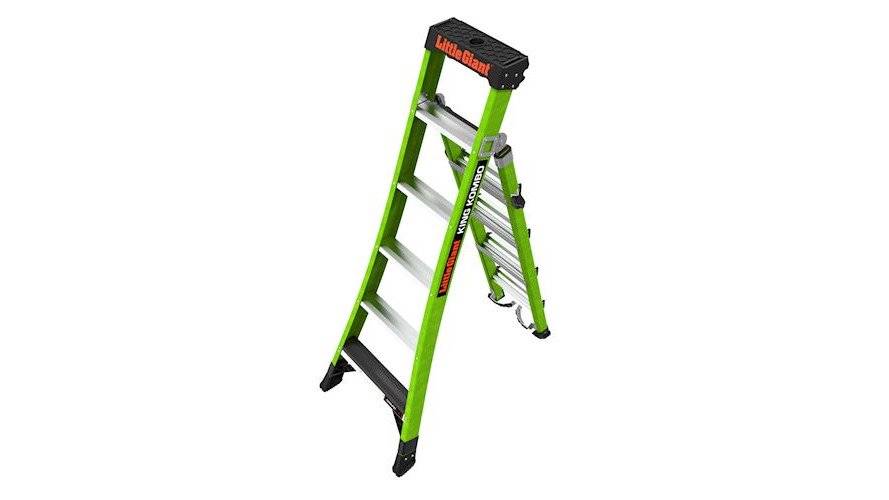
Conquest® 2.0 Fiberglass: Non-Conductive Safety
Conquest 2.0 Fiberglass prioritizes electrical safety with non-conductive construction. It includes independent side stabilizers, Tip & Glide wheels, and multiple configurations.

At 717 BGN, it costs slightly more than aluminum but the safety benefit is essential for electrical work.
Choose this model if your crew includes electricians or if you regularly work in environments where electrical contact is a risk. It's heavier than aluminum, but electrical safety is non-negotiable.
Safety Cage® 2.0: Protected Work Platform
Safety Cage 2.0 isn't a traditional ladder, it's a work platform with integrated safety. The enclosed basket provides 360-degree access and allows two-handed work without gripping the ladder. Adjustable outriggers provide lateral stability on uneven terrain, and industrial wheels let you reposition without collapsing the system.
At 1442 BGN, the fiberglass construction is non-conductive, and the Ground Cue system prevents accidents.
This model is for specialized tasks, high-access work that requires extended time at height, or situations where worker safety is paramount.
Choosing the Right Ladder for Your Job Site
Different construction tasks demand different ladder features. Roofing needs reach and stability. Electrical work needs non-conductive materials. Interior tasks need lightweight portability. The right choice depends on what your crew actually does most often.
Roofing and Gutter Work
Roofing requires a ladder that reaches height safely and won't slip on pitched surfaces or gutters. Extension mode matters here, you need vertical reach. The ladder must sit stably against the wall or roof edge without rocking.
Electrical Installation and High-Voltage Work
Electrical work near power lines demands non-conductive materials. Fiberglass eliminates shock risk, which is non-negotiable for safety. You also need stability, electricians often work with both hands on equipment, not gripping the ladder.
General Construction and Interior Tasks
General construction, framing, drywall, interior painting, fixture installation, benefits from lightweight, versatile systems. Weight matters because you're moving the ladder frequently between rooms and floors.
Storage and Transport on Work Trucks
Multi-functional ladders solve a truck-space problem. One ladder replacing three means more room for other tools and materials. But storage still matters, you need a system that's secure, accessible, and doesn't damage the truck bed or other equipment.
| Model | Starting Price | Best For | Key Advantage |
|---|---|---|---|
| Velocity 2.0 | 401 BGN | General construction, lightweight needs | Portable, affordable entry point |
| Conquest All-Terrain | 525 BGN | Varied terrain, outdoor work | Independent stabilizers, terrain adaptability |
| Revolution 2.0 | 567.60 BGN | Professional crews, comfort priority | Type IA rated, wider steps, smooth adjustments |
| King Kombo 2.0 XT | 720 BGN | Multiple tasks, limited storage | 4-in-1 versatility, non-conductive fiberglass |
| Conquest 2.0 Fiberglass | 717 BGN | Electrical work, high-voltage safety | Non-conductive, terrain-capable |
| Safety Cage 2.0 | 1442 BGN | Extended high-access work, maximum safety | Protected platform, two-handed work capability |
OSHA ladder safety standards and placement requirements

EN131 certification standards for ladder safety
ANSI ladder duty ratings and load capacity classifications
Frequently Asked Questions
What makes a multi-functional ladder suitable for construction sites?
A construction-grade multi-functional ladder needs a 150 kg load capacity, multiple position configurations (A-frame, extended, 90-degree, staircase mode), adjustable leveling feet for uneven terrain, locking hinges for secure transitions, and compliance with EN131 standards. Models like Conquest® All-Terrain combine these features with independent stabilizers that adapt to job site conditions, ensuring stability on slopes, gravel, and uneven surfaces where standard ladders fail.
How do industrial ladder weight ratings affect safety?
Industrial ladder weight ratings indicate the maximum safe load the ladder supports, including the user's body weight plus tools and equipment. Most professional-grade construction ladders carry a 150 kg rating. This capacity matters because exceeding it compromises the ladder's structural integrity, increases pinch-point hazards, and voids warranty coverage. Always verify the duty rating matches your crew's combined weight and tool load.
Why is ladder stability on uneven ground critical for construction sites?
Construction sites rarely have level surfaces. Uneven terrain creates tipping risks and uneven weight distribution, leading to falls and injuries. Multi-functional ladders with adjustable leveling feet and independent stabilizers (like those on Conquest® 2.0 PRO) compensate for slopes and rough ground by extending individual legs to maintain a level platform. This feature is essential for roofing, foundation work, and landscaping where terrain varies significantly across the job site.
Are fiberglass ladders better for electrical work than aluminum?
Yes, for electrical work at height. Fiberglass ladders are non-conductive, protecting workers from electrocution when working near live wires or power lines. Conquest® 2.0 Fiberglass meets this requirement with its Hi-Viz green construction and 150 kg capacity. Aluminum ladders conduct electricity and should never be used near electrical hazards. If your crew regularly handles electrical installation or maintenance, a non-conductive fiberglass model is the safer, code-compliant choice.