

Table of Contents
- What Makes Professional Ladders More Stable Than Standard Ladders
- Most Stable Ladder Types for Professional Use
- Professional Ladder Safety Features That Prevent Falls
- How to Set Up a Ladder Safely on Any Jobsite
- The Ladder 4 to 1 Rule and How It Affects Stability
- Load Capacity, Duty Ratings, and User Movement
- Maintenance and Wear: When Stability Starts to Slip
- Conclusion
- Frequently Asked Questions
Last Updated: October 13, 2026
What Makes Professional Ladders More Stable Than Standard Ladders
A professional ladder is a work platform built to a higher duty rating, with a wider base and stronger frame than a consumer model. That extra material is the difference between a ladder that shifts under you and one that stays planted. At Distributor of Little Giant LTD, we supply ladders to contractors, electricians and maintenance teams who work on ground that is rarely flat. This guide explains why professional ladders offer better stability, what to check before you climb, and how to spot the moment a ladder starts to fail.
Most people buy a ladder once and never think about it again until something goes wrong. The gap between a cheap ladder and a professional one is not marketing. It is base width, frame rigidity and load rating.
Below, we break down the structural reasons, the most stable ladder types, and the setup habits that keep you upright.
The Definition of a Professional Ladder
A professional ladder is a ladder manufactured and certified for frequent use in commercial and industrial settings, rather than occasional household tasks. It carries a higher duty rating, a wider base and heavier components than a standard ladder of the same height.
That definition matters because "professional" is not a colour or a price tag. It is a set of measurable build choices.
Structural Differences That Improve Stability
Three things do most of the work: base width, frame rigidity and foot design.
A wider base spreads your weight over a larger area. That reduces the chance of sideways tipping when you lean out to reach something. Professional models often add outriggers or stabilisers that push the base wider still.
Frame rigidity matters just as much. A flexible frame twists as you climb, and that twist travels down to the feet. Stiffer frames keep the load path straight.
Then there are the feet. Rubber feet with a deep tread grip hard surfaces. Some professional ladders use adjustable legs so each foot can meet the ground independently.
Most Stable Ladder Types for Professional Use
The most stable ladder types for professional work are platform ladders, multi-position ladders and heavy-duty extension ladders with levelling systems. Each solves a different problem, so the right pick depends on your task.
Platform Ladders vs Step Ladders
A platform ladder gives you a flat standing area with a guardrail. That means hands-free work at height, which is where a step ladder falls short.
A step ladder is lighter and faster to move. For quick tasks under two metres, it is often the better tool.
The trade-off is clear:
- Platform ladder: more stable, better for long tasks, heavier
- Step ladder: more portable, fine for short jobs, less support at the top
Multi-Position and Telescopic Ladders
Multi-position ladders convert between A-frame, extension and scaffold modes. That flexibility means one ladder can handle roofing, electrical work and general construction.
Telescopic ladders collapse small for transport. They suit service vans with tight storage.
The catch is that a telescopic ladder needs a firm, flat surface. Its narrow footprint makes it less forgiving on soft ground than a multi-position model with adjustable legs.
| Ladder Type | Best For | Stability Strength | Main Limitation |
|---|---|---|---|
| Platform ladder | Long tasks, hands-free work | Wide base, guardrails | Heavier to move |
| Multi-position ladder | Varied tasks, uneven ground | Adjustable levelling legs | Costs more upfront |
| Telescopic ladder | Van storage, light service work | Compact and light | Needs flat, firm ground |
| Extension ladder | Reaching height | Long reach | Angle must be set right |
Professional Ladder Safety Features That Prevent Falls
Professional ladder safety features are the parts designed to stop a slip before it becomes a fall. They include non-slip rungs, wide standing platforms, guardrails and levelling systems.
Non-slip rungs matter more than most people realise. Wet boots on a smooth rung are a common cause of slips on site.
Wide rungs and a deep platform reduce foot fatigue. Tired legs make mistakes near the top of a ladder.
Levelling systems are the feature that separates professional gear from consumer gear. They let each leg adjust to the ground, so the ladder sits level even on a slope.
How to Set Up a Ladder Safely on Any Jobsite
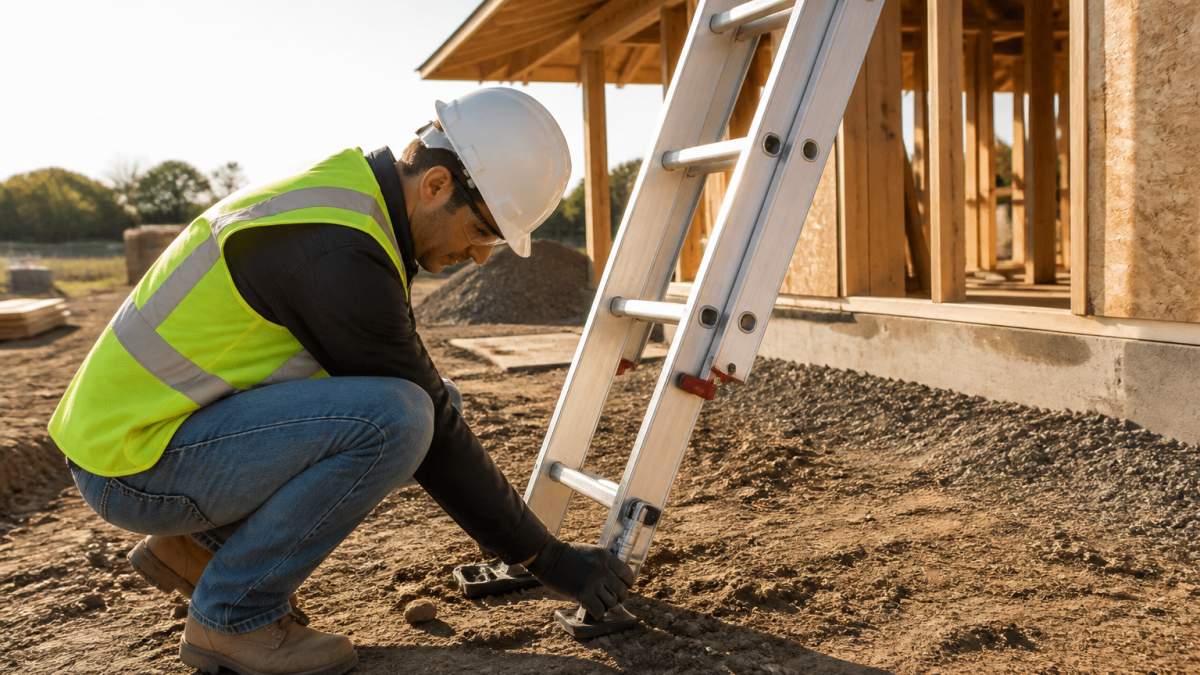
Safe setup follows a fixed order: position, level, test, then climb. Rushing any of these steps is how most ladder incidents start. The difference between a professional and a consumer ladder is most obvious on ground that is not flat, so this section focuses on the conditions that actually cause falls.
Pre-Use Stability Checks
Run through this list every time, even for a two-minute job:
- Check the ground for soft spots, debris or oil
- Confirm all four feet sit flat and firm
- Lock every hinge and spreader bar
- Test the ladder with your weight on the bottom rung
- Check rungs and rails for cracks or bends
- Confirm the ladder sits at the correct angle
The Health and Safety Executive guidance on ladder safety sets out the same principle: ladders should be inspected before use and positioned so they cannot slip.
Handling Uneven, Soft, or Slippery Surfaces
Uneven ground is where standard ladders fail. A fixed-leg ladder on a slope has only two points of contact doing the real work. Professional ladders solve this with adjustable legs or outriggers. You extend each leg until the ladder sits level, then lock it. The key is to adjust before you climb, not after you feel it rock.
On soft ground, use a load-spreading board under the feet. A piece of plywood or a purpose-made ladder mat increases the surface area and stops the feet from sinking. On slippery surfaces, clean the feet and the floor before you set up. Rubber feet lose grip when coated in oil, mud, or sawdust, so wipe them down.
If the ground cannot be made safe, do not climb. No deadline is worth a fall.
Verifying Stability During Use
Stability is not a one-time check. As you work, your movement shifts the load. Keep your belt buckle inside the rails, and avoid reaching sideways more than an arm's length. If you feel the ladder start to shift, stop, climb down, and reset it. A common pattern is that the ladder feels solid on the first step but rocks once you put weight on the third rung. That is why the pre-use test with your full weight on the bottom step matters, it reveals play before you are committed.
The Ladder 4 to 1 Rule and How It Affects Stability
The ladder 4 to 1 rule states that for every four units of working height, the base of a leaning ladder should sit one unit out from the wall (Safe use of ladders and stepladders). A ladder reaching four metres up needs its feet one metre back.
That angle is not arbitrary. Too steep and the ladder tips backward. Too shallow and the feet slide out.
The Occupational Safety and Health Administration guidance on ladder angles describes the same ratio, which is why it appears in training across the industry.
For non-conductive work, fibreglass ladders are the standard choice. Fibreglass does not conduct electricity, which matters when you are working near live circuits or overhead lines.
Load Capacity, Duty Ratings, and User Movement
Load capacity is the total weight a ladder is built to carry, including you, your tools and your materials. Duty rating is the standard that sets that limit.
A common mistake is counting only body weight. A tool belt, a drill and a bucket of fixings can add a lot to the total.
Movement matters too. Reaching sideways shifts your centre of gravity outside the ladder's base. That is when tipping starts.
The fix is simple: keep your belt buckle inside the rails, and move the ladder rather than overreaching.
Maintenance and Wear: When Stability Starts to Slip
Stability degrades slowly, which is why it catches people out. A ladder that felt solid last year can develop play in the hinges without any visible damage.
Check these points monthly on ladders in daily use:
- Hinge pins and locking mechanisms for play
- Feet for worn tread or missing rubber
- Rungs for bends, cracks or loose rivets
- Rails for dents that affect the straight line
- Labels and rating plates for legibility
Any ladder with a bent rail or a cracked rung should be taken out of service. Repairs to structural parts are not a job for a workshop welder.
Conclusion
Keeping a ladder steady on real jobsite ground is the hard part of working at height. Standard ladders leave you guessing. Professional ladders give you a wider base, a stiffer frame and levelling legs that adapt to the surface under you.
Distributor of Little Giant LTD supplies multi-functional ladders built for exactly that problem. Our range includes the HyperLite® with Sumostance®, which uses external stabilisers to more than double the base width, and the Conquest™ 2.0 PRO with all-terrain levelling legs and safety rails. Every model carries a 150 kg load capacity and EN131 certification.

See our ladders and pick the one that matches your work.
Frequently Asked Questions
Which ladder is the best for stability?
Platform ladders and multi-position ladders with wide bases and leveling legs offer the best stability. Models like the HyperLite with SumoStance double the base width for lateral stability, while the Conquest 2.0 PRO uses extending leveling legs to stay stable on uneven ground. Look for non-slip feet, a 150 kg load capacity, and EN131 certification.
How to make a ladder more stable?
Set the ladder on firm, level ground and engage any leveling legs. Maintain three points of contact, avoid overreaching, and keep your body centered between the rails. Use a ladder with a wide base and non-slip feet like the Velocity 2.0 PRO. For extra stability, consider a model with SumoStance or all-terrain leveling legs.
What is the 4 to 1 rule of ladder?
The 4 to 1 rule states that for every 4 metres of working height, the base of the ladder should be 1 metre away from the wall. This angle (about 75 degrees) prevents the ladder from tipping backward or sliding out. Apply this rule every time you set up an extension or leaning ladder to maintain safe footing.
What features make a professional ladder more stable?
Key features include a wide base, non-slip feet, leveling legs, and rigid frame construction. Professional ladders often have extra-wide rungs, guardrails, and a 150 kg load capacity. Models like the MightyLite include a Ground Cue system to signal safe descent. These features reduce lateral movement and prevent tipping on uneven surfaces.